


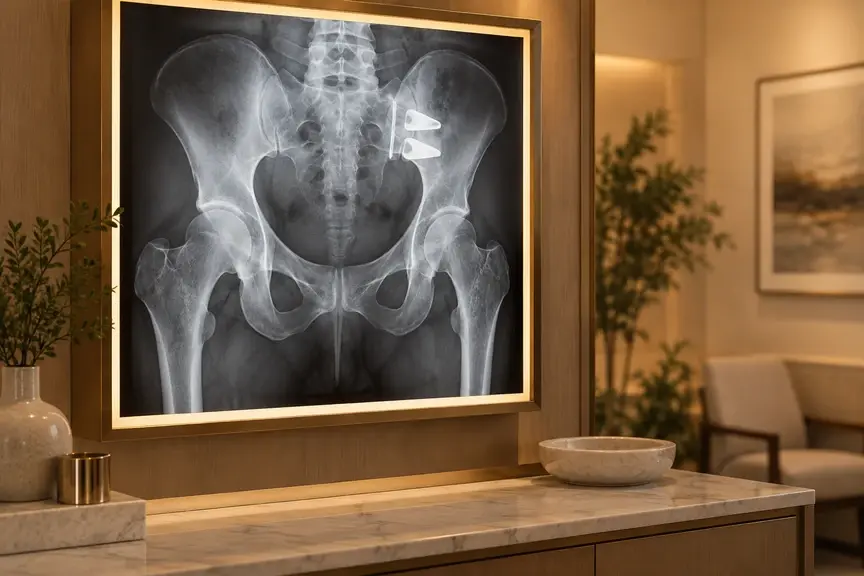
What is a sacroiliac joint fusion?
The sacroiliac joints sit either side of the sacrum, one on each side of the pelvis. They move very little, but they carry high loads every time you walk, stand or lift. A sacroiliac joint fusion stabilises the joint by placing small implants across it, so that movement is reduced and bone gradually knits across the surfaces. The aim is to settle pain that has been proven to arise from that joint.
In the UK, the procedure is usually performed through small incisions rather than as open surgery. It is only considered once simpler treatments have been tried and the diagnosis is clear.
Is sacroiliac joint fusion right for me?
Surgery is considered when pain over the buttock or low back is confirmed as coming from the sacroiliac joint, usually with a guided injection, and when physiotherapy and injections have not given lasting relief. Getting the diagnosis right is the most important step of all. Mr Mark Edmondson will normally look for the following before discussing surgery:
- Pain present for several months despite structured physiotherapy
- Clear findings on examination that point to the sacroiliac joint
- Imaging that has ruled out other causes, such as hip arthritis or nerve compression
- A convincing, if temporary, response to an image guided local anaesthetic injection
- A realistic understanding of what surgery can and cannot achieve
What happens on the day of surgery?
The procedure is usually minimally invasive, performed through small incisions under X-ray guidance and regional anaesthesia. Live imaging guides implant placement, so accuracy can be checked throughout. Surgery time varies depending on the individual case. Many patients go home the same day or after one night, depending on comfort, mobility and general health. Most people begin gentle movement soon afterwards, with recovery guided step by step from the day of surgery.
What are the risks of surgery?
Every surgical procedure carries risks; the risks using this approach to joint fusion are dramatically reduced.
- Bleeding: bruising is common and not a concern; more serious bleeding which may require return to theatre is extremely rare.
- Infection: this is less than 1% and normally can be managed with antibiotics alone; rarely the implant may have to be removed if the infection is severe.
- Nerve injury: there is a risk of damaging the nerve roots near to the SI joint, which affect the skin of the side of the calf and foot, and occasionally in severe cases may lead to a foot weakness, although this is rare due to continuous imaging throughout the procedure to ensure the dangerous regions are avoided.
- Failure: there is a risk that this may not cure all of your symptoms, as commonly other joints (spine and hip) can be also involved in generating your pain.
Your Recovery, Week by Week
Day of Surgery
Day case procedure; weight bearing with crutches straight away, discharge home the same day or after one night, depending on comfort, mobility and general health.
Weeks 1-4
About 50% of your weight through the fused side for the first 3-4 weeks; wounds checked at 2 weeks.
Week 4 Onwards
Weight bearing gradually increases to full as pain allows.
Week 6
Progress checked with an X-ray; most patients confident walking without crutches and able to drive by this point; those with desk-based jobs typically return to work in this window; cycling should be avoided for the first 6 weeks.
Up to 3 Months
Manual workers may need up to three months to return to normal.
Risks and honest conversations
Like any operation, sacroiliac fusion carries risks, and it only helps when the joint is truly the source of pain. Mr Edmondson talks through the risks that apply to you and how each is reduced. No promises are made about outcomes, and that honesty is part of the care.
Patient Story
“Mr. Edmondson was very informative and explained the process from beginning to end I felt in good hands and fully confident that my procedure would be a success.”
Anonymous feedback, Montefiore Hospital
Book a consultation
Clinic Times
Mon
Nuffield Haywards Heath, 8:30-17:30
Tue
Spire Montefiore, Hove, 8:00-17:30
Fri
Nuffield Haywards Heath, 10:30-13:00